We Learn on the Go (1/3)
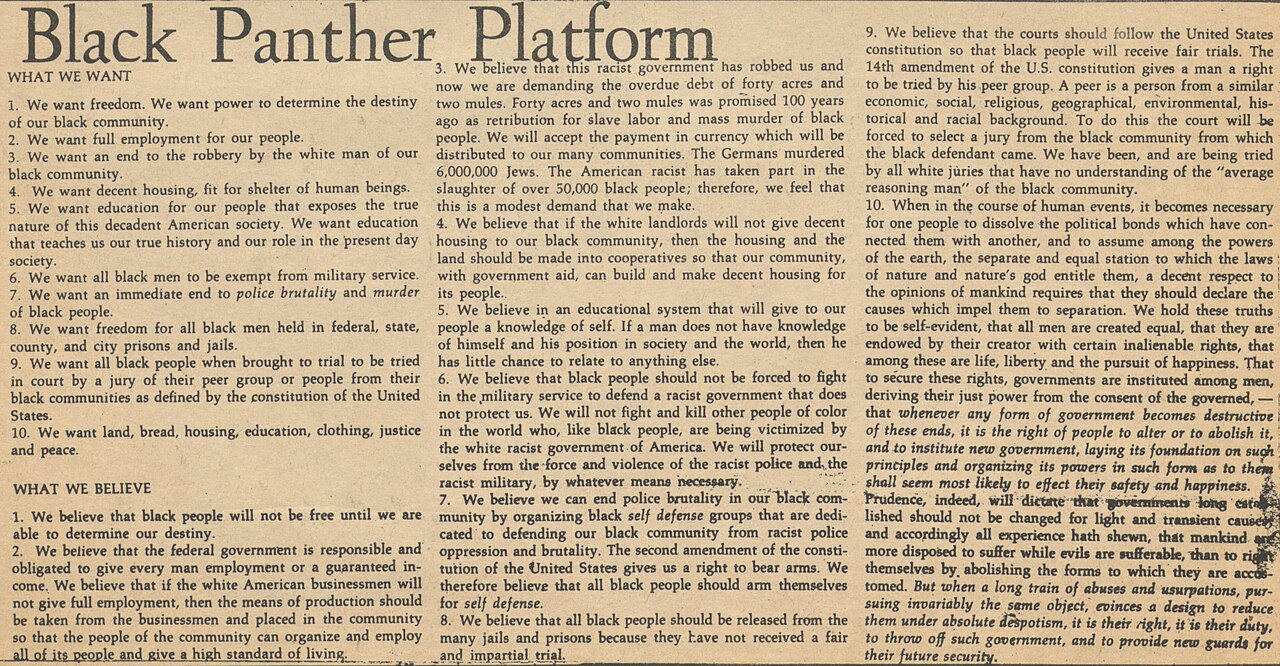
10. WE WANT LAND, BREAD, HOUSING, EDUCATION, CLOTHING, JUSTICE, PEACE AND PEOPLE'S COMMUNITY CONTROL OF MODERN TECHNOLOGY.
... We hold these truths to be self-evident, that all men are created equal; that they are endowed by their Creator with certain unalienable rights; that among these are life, liberty, and the pursuit of happiness. That, to secure these rights, governments are instituted among men, deriving their just powers from the consent of the governed; that, whenever any form of government becomes destructive of these ends, it is the right of the people to alter or to abolish it, and to institute a new government, laying its foundation on such principles, and organizing its powers in such form, as to them shall seem most likely to effect their safety and happiness.
The Black Panther Party Program's point 10 repeats word-for-word the first paragraphs of the US Declaration of Independence - joining other Civil Rights activists in reminding the country that, as far as Black people were concerned, its founding principles were a bad check that had come due.
In case you live on Mars, heads up, the United States declared independence 250 years ago yesterday.
This isn't the only revolutionary declaration celebrating an anniversary - early July seems to be a prime time for them. On today's date in 1811, representatives of 7 out of 10 provinces of Venezuela declared independence from Spain, the first South American country to do so. The timing intentionally echoed their North American predecessor, so did some of the wording. Much later, quite coincidentally, the Politburo of the Yugoslav Communist Party met on 4 July 1941 to discuss how to respond to the Nazi German invasion of the Soviet Union, and issued a call for a general guerilla uprising against the Axis occupiers. Early Julys 1789 and 1917 were respectively pivotal in French and Russian Revolutions, but let's not get carried away.
I argued recently that a world revolution is now under way, and that survival dictates we take charge of steering it. It'd be neat if I followed this now with an eloquent call for a revolt, right on cue.
Not quite yet - there's ground to cover before venturing that far. I will, however, take the opportunity to assess the present moment in light of these declarations and the revolutionary movements that issued them. Note that none is a good model to follow - for one, they all hinged on military successes in outlasting and ejecting external occupying forces, and that's not what we're facing now. However, there are commonalities with our present circumstances that make them worth picking for lessons.

All three revolts - in the United Colonies, Spanish Latin America, and occupied Yugoslavia - were asymmetric, fought against more powerful, formidable opponents. At the time the declarations were issued, each was at an early stage, when success was a long shot and the eventual outcome impossible to discern. Yet, all three defied the odds and emerged victorious.
So let's see what we can learn.
There are three questions to ask, so I'll split this post into three. This is part one, parts two and three will follow soon.
Let us start with the big one:
1. What kind of society would secure our future?
If, indeed, dominant social, political, and economic arrangements of the last several centuries promote growth - a continuous increase in the portion of the global ecology humans exploit, exacerbating its collapse - then, to build a world in which we can survive and thrive, we must, word has it, alter or abolish any such institutions. The list of what we need to challenge, by no means definite, includes: the profit motive, wage labor, debt currencies, state-administered property rights over land and resources, significant class differences within countries, GDP as a benchmark of prosperity, competitive sovereign nation states.
This is an immense task. Even if we can chase away some of the dizziness by reminding ourselves that we have options, this does little to tell us what, specifically, to aim for. Our cultures and histories provide a wealth of alternative paths to choose from, and we can devise even more, but how does that help? How do we know which ones to try out?
In all, the honest answer to the question is
We don't know.
This feels unsatisfying, even unserious. Really? We have so much knowledge at our disposal, so much expertise to draw on, and we don't know how to set up our affairs to get out of this mess?
The three historical examples, encouragingly, all remind us that
we don't need to know.
That sounds daft, but really, none of the three revolutions aimed at specific institutional arrangements. Each had, and it sufficed it to have, a general idea of what would constitute success - principles the new society would be based on, ballpark political settlements that could uphold them - but with a wide range of disagreement and flexibility in details.
So for instance, US founders were committed to white supremacist liberal constitutionalism - the dominance of white settlers already established and, by design,1 never too openly touted, the remainder novel and duly spelled out. But it took over a decade to work out a constitution that fit the bill, the initial loose confederation grudgingly superseded by a tightly bound federal republic. South American revolutionaries also wanted sovereignty and constitutional government, but were divided on race and slavery, and on how large and centralized the new nations would be. Independence was won, followed by decades of instability. Yugoslav Communists, for their part, succeeded in creating a multi-ethnic one-party socialist state, but along the way fought a bitter internal feud over loyalty to the Soviet Union. The country did end up authoritarian, shipping dissidents to hard labor camps (one shown below), but it was more politically decentralized and economically liberal than originally envisaged.

So what can we say about the kind of society we should be building now? What's our general idea about what would constitute success?
We know enough, it turns out, to realize we're in a situation that's quite new.
If a human society is sustainable - if, as a whole and in its parts, it maintains and enriches the living world it takes part in, and the human affairs that take part in it - then its arrangements must in some way be responsive to the social and ecological realities.
This in itself isn't new. The revolutions of the last 250 years took care to build political systems that were, if often in principle more than in fact, responsive - to citizen preferences through elections, to worker needs through representation in unions and the party. But, they did not have to take account of either social or ecological conditions to the extent we must today. On the contrary, all were taking place in the context of economic growth, which they pursued and understood as progress. All assumed there would be new natural resources to exploit and turn into material goods, improving overall living standards, suppressing class resentments, enhancing their nations' standing before others.2 True, the successors to these revolutions eventually had to address environmental impacts, but their responses so far have proven inadequate - and given their record, we must, by default, consider them as failures.
What we do now must respond to social and ecological realities at quite another level.
We need to build a society defined by the fact that information about social and ecological processes, explicit or implicit knowledge about them, is, in whatever way, embedded, contained within social relations, cultural practices, economic interactions, political institutions, and physical infrastructure. We need a society which, in some decisive way, builds into its fabric awareness of its own condition and of the well-being of the ecology it forms a part of. As a result, and in addition, because societies and ecologies are in flux, changing every day and unfolding over history, this information cannot take shape of a formula, a boilerplate, a recipe, but itself must be subject to change - updated in an ongoing process of social and cultural learning.

The shape of a future livable society is indeed quite opaque to us, but we know one thing for sure - it will be able to learn.
That's not a lot to go on, but it is a lot more than nothing.
Next time, we'll look at how we may build such a society. After that, we'll ask what we can do right now to get started.
Racism against Black and Indigenous people was constitutive of the independent United States, as Black enslaved labor and expropriation of Indigenous land (thus genocide) were materially essential to the new country's economy. That they were only marginally acknowledged by US founders, that the white lie of the explicit founding principles was later laundered as some kind of a peculiar imperfection or omission, are reasons why acknowledging this remains a third rail in US politics, and why reminders such as the Panthers' and MLK's are still needed today.↩
Even Kropotkin's anarcho-communism, which would dissolve nation states and brooks no tolerance for class difference, promises to deliver material prosperity and progress by growing agricultural and industrial production (The Conquest of Bread, Chapter 2, Section I).↩